

This series of profiles features noteworthy people over the past 250 years who have shaped the American constitutional tradition in various ways. In this post, National Constitution Center content fellow Anna Salvatore looks at the life of Elizabeth Cady Stanton, who helped organize the Seneca Falls Convention of 1848, which launched the movement for women’s rights.
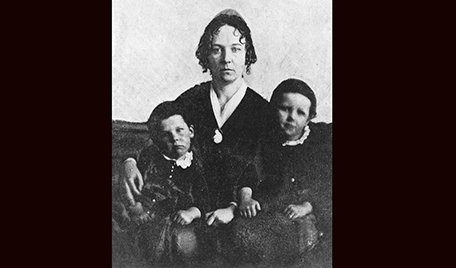 Elizabeth Cady Stanton was born into a prominent family in Johnstown, New York on November 12, 1815, where she lived with her parents, five siblings, and as many as 12 servants in a mansion on the town square. Her father, Daniel Cady, was a distinguished lawyer and politician, and her mother, Margaret Cady née Livingston, ran the house with what her daughter called “queenly and magnificent sway” and “the soul of independence and self-reliance.” They ensured their daughter had a stronger education than most young women of her era. Elizabeth studied debate, Greek, and mathematics at the Johnstown Academy before attending Troy Female Seminary, where she felt the first stirrings of a lifelong distrust of religious revivalism and its constraining effects on young women.
Her political education took place at her cousin Gerrit Smith’s house in upstate New York. Smith, who would help fund John Brown’s raid on Harper’s Ferry, invited a constant stream of abolitionists, temperance advocates, and Native Americans to his stately home on the Underground Railroad. It was there that she met her future husband, Henry Stanton, whom she married just before they visited London for the World Anti-Slavery Convention in 1840. Though women were forbidden to participate, Stanton watched the proceedings closely and befriended fellow spectator and suffragist Lucretia Mott.
Video: Elizabeth Cady Stanton, Women’s Suffrage, and the Legacy of the 19th Amendment
In 1847, at age 31, Stanton moved to Seneca Falls, New York, already the mother of three children. She would go on to have four more between 1951 and 1959. Nearly all of the burdens of housekeeping and childrearing fell to her. Henry, absorbed in his law practice, was also active in the formation of the abolitionist Free Soil Party at the time. Exhausted and isolated by housework, which prevented her from traveling and writing as widely as she would have liked, Stanton expressed her “long-accumulating discontent” to Mott, a Quaker, and other Quaker women in the community in the summer of 1848. They resolved to organize a women’s rights convention in Seneca Falls a few days later.
This gathering, known as the Seneca Falls Convention, took place in the town’s Wesleyan Chapel from July 19–20, 1848. Among the attendees, nearly all of whom were white and female, was the abolitionist Frederick Douglass, who defended Stanton’s controversial resolution in favor of women’s suffrage. She was also the principal author of the Declaration of Sentiments, a remodeling of the Declaration of Independence that placed women’s equality at its center. She listed women’s political grievances against men (“he has compelled her to submit to laws, in the formation of which she had no voice”) in much the same way that American colonists had listed their grievances against King Charles III.
Historic Document: Seneca Falls Declaration (1848)
The Declaration of Sentiments concluded with an urgent demand: “In view of this entire disfranchisement of one-half the people of this country... and because women do feel themselves aggrieved, oppressed, and fraudulently deprived of their most sacred rights, we insist that they have immediate admission to all the rights and privileges which belong to them as citizens of these United States.” It was signed by 100 of some 300 attendees to the convention and reprinted in abolitionist newspapers across the country.
Stanton met the women’s rights reformer Susan B. Anthony in 1851, forming an enduring friendship and partnership that would last the rest of their lives. Anthony excelled at organizing, while Stanton excelled at speeches and written pronouncements. Together they began to link the demands of the temperance and suffrage movements, arguing that liberalized divorce laws would allow women and children to escape subordination by alcoholic fathers. They also played leading roles in the New York Anti-Slavery Society in the 1850s while Henry Stanton helped organize the Republican Party in opposition to the expansion of slavery into western territories.
Stanton had long used slavery in her speeches and writings as a metaphor for women’s subordination to men, but during the Civil War, she increasingly referred to slavery as an evil in itself. In 1861, she joined a speaking tour to call for immediate and unconditional emancipation and “no compromise with slaveholders.” She co-authored an “Address to the Women of the Republic” with Anthony that urged northern white women to defend the war’s “ultimate purpose,” and in 1863, they founded the Women’s National Loyal League to campaign for a constitutional amendment to end slavery. It is considered the first national women’s political organization in U.S. history.
After President Abraham Lincoln’s assassination in 1865, the elections of 1866 brought dramatic wins for Republicans in the House and Senate. Reformers proposed legislation to grant suffrage and the other rights of citizenship to African American men, declaring that it was “the Negro’s hour.” Stanton expressed concern that the 14th Amendment would introduce sex-based distinctions into the Constitution to explicitly exclude women from these rights. In heated debates with other suffragists and abolitionists, she began to display the racism and nativism that would ultimately taint her legacy, declaring boldly that she “would not trust” the Black man with her rights if he were enfranchised first.
In 1870, Stanton and Anthony advanced a legal theory called the “New Departure.” They argued that a constitutional amendment for women’s suffrage was not necessary because the 14th Amendment’s definition of citizenship already implicitly guaranteed women the right to vote. The Supreme Court rejected this strategy in the 1875 decision Minor v. Happersett, ruling that women were citizens, but that suffrage was not one of the rights of citizenship.
In the final years of her life, Stanton collaborated with Anthony on a multi-volume history of the women’s movement. She also published an intensely controversial Women’s Bible, which rewrote and reinterpreted passages of the Bible that had long positioned women as inherently subservient to men. Her activism in this period, she said, was grounded by her understanding of women’s “birthright to self-sovereignty.” Stanton often expressed her resentment that African Americans and immigrants possessed more rights than educated white women, and in the 1890s, she advocated for literacy tests so that “chiefly foreign” labor agitators would not have access to the ballot.
Stanton did not live long enough to see her dreams of enfranchisement fulfilled. She died of heart failure in New York City on October 26, 1902, 17 years before the 19th Amendment was ratified, granting women the right to vote.
Anna Salvatore is a Content Fellow at the National Constitution Center and a graduate of Princeton University.