

Charles Sumner spent nearly a quarter-century in the United States Senate insisting that the federal government had the power and the moral obligation to abolish slavery, and for that conviction, he was nearly beaten to death on the Senate floor in 1856. He lived to help push President Abraham Lincoln toward emancipation and to shepherd the Reconstruction amendments through Congress, though his fuller vision of “the centralism of liberty … [and] the imperialism of equal rights” stayed beyond the nation’s reach for generations.[1]
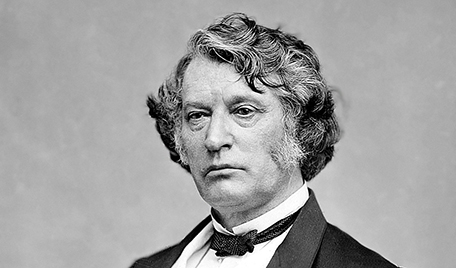 Sumner was born in Boston on Jan. 6, 1811, as the eldest of nine children. His father, Charles Pinckney Sumner, was a lawyer and county sheriff who harbored antislavery views unusual for his time and class. After graduating from Harvard College in 1830 and Harvard Law School in 1833, Sumner spent two years traveling and studying in Europe before returning to Boston to practice law.
Sumner initially devoted himself to reform causes rather than electoral politics, writing and lecturing on prison conditions, public education, and the peace movement. In 1845, he delivered a Fourth of July address in Boston attacking the Mexican-American War as an instrument of slaveholder expansion. “War crushes with bloody heel all justice, all happiness, all that is Godlike in man,” he said. “In our age there can be no peace that is not honorable; there can be no war that is not dishonorable.”[2] Sumner aligned first with the Conscience Whigs and then with the Free Soil Party before a coalition of Free Soilers and Democrats elected him to the U.S. Senate in 1851.
Sumner’s Political Career
Sumner arrived in the Senate as part of a Free Soil-Democratic coalition and quickly established himself as the chamber’s most unsparing antislavery voice. In his 1852 speech, “Freedom National, Slavery Sectional,” he argued that the Constitution nowhere recognized property in man and that slavery was a purely local institution with no legitimate claim on federal protection, declaring himself “painfully convinced of the unutterable wrongs and woes of slavery” and that it could “find no place under our National Government.”[3] When Congress passed the Kansas-Nebraska Act in 1854, repealing the Missouri Compromise and opening new territories to slavery, Sumner helped organize the opposition that coalesced into the Republican Party.
On May 19, 1856, Sumner rose in the Senate to deliver what would become the most consequential speech of his career. “The Crime Against Kansas” was a two-day assault on the pro-slavery violence convulsing the territory and the senators whom he held responsible. He described Southerners’ effort to force slavery on Kansas as “the rape of a virgin Territory” and mocked Sen. Andrew Butler of South Carolina for taking as a mistress “… the harlot, Slavery.”[4] Two days later, Butler’s cousin, Rep. Preston Brooks, entered the Senate chamber and violently assaulted Sumner with a metal-tipped cane, leaving him with such severe neurological damage that he did not return to Congress for three years.
During the Civil War, Sumner argued from the first day of fighting that Lincoln had the authority to order emancipation under martial law. He met with the president frequently, pressing him to abandon proposals for gradual emancipation and to make the abolition of slavery the war’s central objective. In an 1864 letter to Lincoln, he wrote that “freedom once given could not be reclaimed, & that the country was solemnly bound to the immediate present freedom of every slave in the rebel states.”[5] As chairman of the Senate Foreign Relations Committee, he drew on his long friendships with British liberals Richard Cobden and John Bright to navigate the Trent Affair, persuading Lincoln to release two captured Confederate diplomats and defuse a crisis that might have brought Britain into the war on the Confederate side.[6]
Activities during Reconstruction
The Reconstruction era (1865-77) brought Sumner to the height of his influence and the outer limits of his radicalism. He fought for full civil and voting rights for freed people, insisting that the Constitution, read alongside the Declaration of Independence, demanded for African Americans the protections afforded to any citizen. His guiding conviction, which historian Eric Foner identified as central to the entire Reconstruction project, was that the federal government was “the custodian of freedom,” a direct rebuke to the antebellum view that states alone determined the rights of their citizens.[7]
The culminating fight of Sumner’s career was the Civil Rights Act of 1875, which he had first introduced in 1870 and described as the “crowning work” of Reconstruction.[8] The bill forbade racial discrimination in all forms of public accommodation — transportation, hotels, theaters, schools, and cemeteries — and criminalized the exclusion of Black citizens from jury duty. It was the most ambitious civil rights legislation the country had ever seen. One critic argued that Sumner’s legislation would force “social equality with an inferior race,” to which Sumner replied that if his belief in liberty and equality as the “God-given birthright of all men” was an error, then “it is an error which I love; if this be a fault, it is a fault which I shall be slow to renounce.”[9]
Before he died in March 1874, Sumner’s final words to Frederick Douglass and others at his bedside were, “Don’t let the bill fail.”[10] Thousands of mourners paid their respects at the Massachusetts State House, where his coffin rested before his funeral at King’s Chapel; the procession then followed his flower-draped coffin for the five-mile walk from Beacon Hill to Mount Auburn Cemetery. Among his pallbearers were Henry Wadsworth Longfellow, Oliver Wendell Holmes, Ralph Waldo Emerson, and John Greenleaf Whittier.
Congress passed a weakened version of the Civil Rights Act the following year, though it stripped out all references to equal and integrated education to make it more palatable to white voters. In 1883, the Supreme Court struck down the act’s public accommodations provisions entirely, ruling that the 14th Amendment restrained only the states, not private individuals. It would take another century and another civil rights movement to continue what Sumner had started.
Anna Salvatore is a Content Fellow at the National Constitution Center and a graduate of Princeton University.
Notes
[1] Charles Sumner, quoted in C.N. Douglas, comp., Forty Thousand Quotations: Prose and Poetical (New York: Halcyon House, 1917), Bartleby.com, https://www.bartleby.com/lit-hub/forty-thousand-quotations-prose-and-poetical/authors/charles-sumner/.
[2] Excerpt taken from Charles Sumner, The True Grandeur of Nations: An Oration Delivered before the Authorities of the City of Boston, July 4, 1845 (Boston: American Peace Society, 1845).
[3] Charles Sumner, “Freedom National, Slavery Sectional,” speech delivered in the United States Senate, August 26, 1852, EmersonKent.com, https://www.emersonkent.com/speeches/freedom_national_slavery_sectional.htm.
[4] Charles Sumner, “The Crime Against Kansas,” speech delivered in the United States Senate, May 19–20, 1856, in The Works of Charles Sumner, vol. 4 (Boston: Lee and Shepard, 1875).
[5] Charles Sumner to Abraham Lincoln, November 20, 1864, Manuscript Division, Library of Congress, reproduced at United States Capitol Visitor Center, https://www.visitthecapitol.gov/artifact/letter-charles-sumner-abraham-lincoln-november-20-1864.
[6] “Charles Sumner,” Encyclopaedia Britannica, https://www.britannica.com/biography/Charles-Sumner.
[7] Eric Foner, “The Strange Career of the Reconstruction Amendments,” Bloomberg, August 17, 2010, https://ericfoner.com/articles/08172010bloomberg.html.
[8] “Civil Rights Act of 1875,” Encyclopedia.com, https://www.encyclopedia.com/social-sciences-and-law/law/law/civil-rights-act-1875.
[9] Charles Sumner, speech on the Civil Rights Bill, United States Senate, 1866, autograph quotation reproduced at Raab Collection, https://www.raabcollection.com/american-history-autographs/sumner-famous-speech-civil-rights-bill.
[10] “Landmark Legislation: Civil Rights Act of 1875,” United States Senate Historical Office, https://www.senate.gov/artandhistory/history/common/generic/CivilRightsAct1875.htm, citing David Donald, Charles Sumner and the Rights of Man (New York: Alfred A. Knopf, 1970).