

In part one of a two-part series, Charles Sahm examines how Black Americans, free and enslaved, seized on the promises of the preamble to the Declaration of Independence.
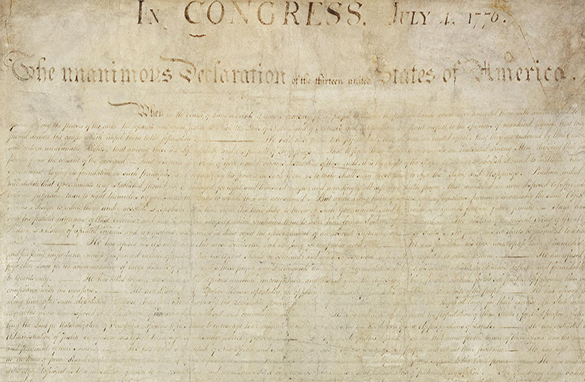 The words that begin the second paragraph of the Declaration of Independence are considered our nation’s creed: “We hold these truths to be self-evident, that all men are created equal, that they are endowed by their Creator with certain unalienable Rights, that among these are Life, Liberty and the pursuit of Happiness.”
But that wasn’t always the case. One of the underappreciated facts of American history is that it was Black Americans, free and enslaved, who were the first to interpret the phrase “all men are created equal” as a statement of individual equality and have employed it most often and most eloquently over the past 250 years to advance liberty and equality for all Americans.
As historian Pauline Maier argued in her seminal book American Scripture, in 1776 and for decades after, the Declaration was not regarded as the sacred text it is today. “It was Independence, not the Declaration, that the people celebrated,” Maier wrote. “And when they quoted that document, they cited the last paragraph, the one that proclaimed that ‘these united colonies are and of right ought to be free and independent states.’… There was comparably little attention—indeed, so far as I can tell, none at all—to the document’s second paragraph.”
Maier may have overstated the case a bit. Recent scholarship by Eric Slauter has documented abolitionists such as Anthony Benezet, who cited the Declaration’s preamble, while Danielle Allen notes that James Wilson invoked the Declaration’s preamble at the Pennsylvania ratifying convention. David Armitage has also demonstrated how British observers recognized the glaring contradiction between the Declaration’s claim of equality and the existence of American slavery.
But Maier’s larger point holds true: most white Americans did not view the preamble as a statement of individual liberty and equality in the founding era and early republic. Jesse Wegman in his new biography of James Wilson, The Lost Founder, cites the work of University of Pennsylvania professor William Ewald to highlight the fact that none of the founders besides Wilson, ever used the words “created equal” or any of the other key phrases from the preamble. A survey by the historian Mark Graber finds that before Abraham Lincoln, no president had ever invoked the phrase “all men are created equal.”
But Black Americans quickly seized on the Declaration’s egalitarian promises. It is important to note that the Black freedom struggle predates the American Revolution. However, the Declaration’s preamble handed Black Americans a powerful ideological and rhetorical weapon, which they employed as “a battle cry for freedom,” according to historian Benjamin Quarles.
Just weeks after the Declaration was signed, the mixed-race religious leader Lemuel Haynes’s freedom jeremiad, “Liberty Further Extended: Or Free Thoughts on the Illegality of Slave-Keeping,” used its preamble to advance the legal and philosophical argument for abolition. In 1777, Prince Hall, a formerly enslaved Black Bostonian, authored a petition to the government of Massachusetts, employing the Declaration’s language of “natural and unalienable rights,” linking the colonists’ “glorious struggles for liberty” with the cause of Black freedom.
Citing the Declaration as a promise of freedom
Below are some lesser-known examples of African Americans using the Declaration to advocate for their freedom and civil rights during the 50 years between 1779 and 1829, when it became more common to view the Declaration as a touchstone for equality.
In 1779, a group of 19 enslaved men submitted a freedom petition to the New Hampshire Assembly stating: “The God of Nature gave them Life and Freedom, upon terms of the most perfect Equality with other men; That freedom is an inherent Right of the human Species, not to be surrendered but by Consent.” The group included Prince Whipple, an enslaved aide to General William Whipple, Jr., a signer of the Declaration.
In 1781, the enslaved woman Mum Bet, who later changed her name to Elizabeth Freeman, sued for her freedom in Brom and Bett v. Ashley. (Brom, an enslaved man, joined her case.) Her argument was that slavery violated the Massachusetts Constitution. The jury agreed, and the court granted her freedom (and back wages). Her freedom suit, combined with a 1783 suit brought by an enslaved man, Quock Walker, led to the de facto abolition of slavery in Massachusetts.
In 1783, an anonymous writer published an essay in the Maryland Gazette under the pseudonym “Vox Africanorum.” Although the essay is written from the viewpoint of an enslaved person, the race of the writer is unknown. Reminiscent of the “What to the Slave Is the Fourth of July?” speech that fellow Marylander Frederick Douglass would deliver 69 years later, the author notes: “Liberty is our claim…. Has not the wisdom of America solemnly declared it? Attend to your own declarations—‘These truths are self-evident.’ ”
In 1791, while surveying the new District of Columbia, Benjamin Banneker, a Black mathematician and scientist, sent a letter to Thomas Jefferson, then secretary of state, confronting him with his own words from the Declaration. Banneker calls “pitiable” the idea that Jefferson would advocate for these “rights and privileges” while “detaining by fraud and violence so numerous a part of my brethren under groaning captivity and cruel oppression.” Jefferson replied, offering little more than vague hope that someday “a good system” will be “commenced” for improving what he calls “the degraded condition” of the enslaved.
In 1797, Jupiter Nicholson, Jacob Nicholson, Job Albert, and Thomas Prichet—four formerly enslaved North Carolina men living in Philadelphia—submitted the first known African American antislavery petition to Congress. In their request to amend the Fugitive Slave Act of 1793, they appealed to federal “public Declarations in favor of Liberty & the common Right of Men.” Congress, by a 50–33 vote, refused to accept the petition for a formal hearing.
In 1799, the prominent ministers Absalom Jones and Richard Allen were two of 71 Black Philadelphians who signed a petition to the U.S. Congress calling for an end to the slave trade and for African American civil rights, arguing that the slave trade and the Fugitive Slave Act violated the Constitution, the Bill of Rights, and “the declaration of Congress. South Carolina representative John Rutledge, Jr., denounced “this new-fangled French philosophy of liberty and equality.” The petition was rejected by an 85–1 vote.
On January 1, 1808, in celebration of the ban on the importation of slaves to the U.S., which became effective that day, Reverend Peter Williams, Jr. delivered “An Oration on the Abolition of the Slave Trade” at the African Zion Church in New York. The published sermon celebrates “that illustrious moment, when the sons of 76 pronounced these United States free and independent; when the spirit of patriotism erected a temple sacred to liberty; when the inspired voice of Americans first uttered those noble sentiments, ‘we hold these truths to be self-evident, that all men are created equal.’”
In 1813, James Forten, a successful Black businessman who had served as a powder boy during the Revolution and claimed to have been present when the Declaration was first read in Philadelphia, published a pamphlet under the pen name “A Man of Colour” that employed the preamble to argue against legislation being considered by the Pennsylvania legislature to restrict Black civil rights. Forten beseeched the legislature not to deprive its Black citizens of “those inestimable treasures, Liberty and Independence.” Forten’s pamphlet succeeded; the proposed legislation was voted down. Forten would go on to use his wealth to fund the abolitionist newspaper The Liberator and the American Anti-Slavery Society.
On July 4, 1827, William Hamilton, a prominent Black abolitionist, delivered a speech at the African Zion Church celebrating the official end to slavery in New York, which had passed a gradual emancipation law in 1799. Hamilton began by quoting “the ever memorable words” of the Declaration’s preamble. He then assailed Jefferson, who had died in the previous year, as “an ambidextrous philosopher” and attacks the “inconsistency of men holding slaves at the same time declaring in the most solemn manner” their devotion to “self-evident truths.” Portions of the oration were published in Freedom’s Journal, the nation’s first African-American-owned and operated newspaper.
In 1829, David Walker, a free African American abolitionist, published “Appeal to the Colored Citizens of the World,” a fiery pamphlet that he distributed throughout the South. In contrast to the pleading tone of many earlier antislavery tracts, Walker blasts Jefferson and the founding generation for their racism and hypocrisy. “See your Declaration Americans!!!,” Walker implored. “Hear your language, proclaimed to the world, July 4th, 1776…. Compare your own language … with your cruelties and murders.” He also invoked the Declaration’s right of revolution: “Hear your language further!... But when a long train of abuses and usurpation … evinces a design to reduce them under absolute despotism, it is their right, it is their duty, to throw off such government.”
In this era before the abolitionist movement gained momentum in the 1830s and 1840s, these early statements by Black Americans set the stage for a broader discussion about what Martin Luther King, Jr. famously called a “promissory note to which every American was to fall heir.”
Part 2: Constitutional Voices: The Declaration as a Constant Call to Freedom
Charles Sahm is the director of content strategy and program development at the National Constitution Center.