


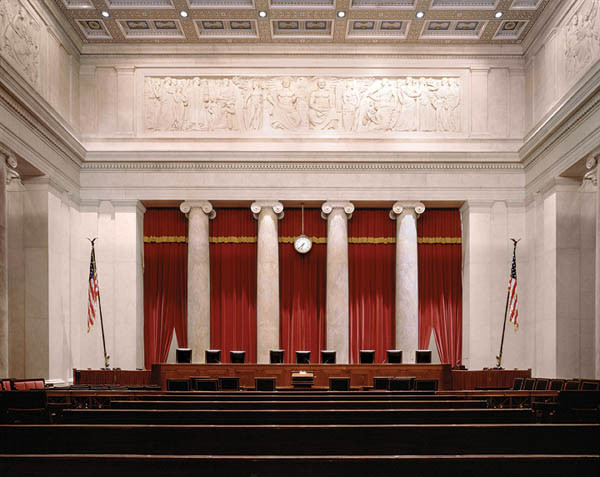
This week, the Supreme Court announced its argument schedule for October 2026, with a dispute over who can sue over the effects of climate change as the first case of its new term.
 In Suncor Energy (U.S.A.) Inc. v. County Commissioners of Boulder County, the justices are presented with several questions involving the federal government’s power to preempt environmental lawsuits from local governments filed in state court. In Article VI, Clause 2, the Supremacy Clause states that “This Constitution, and the Laws of the United States … shall be the supreme Law of the Land; and the Judges in every State shall be bound thereby, any Thing in the Constitution or Laws of any State to the Contrary notwithstanding.”
In this case, Boulder County and the city of Boulder in Colorado sued Suncor Energy, Suncor Energy Sales, and Exxon Mobile in 2018. Boulder claimed a state court could compel energy companies to share “a portion of the financial burden their communities must bear in coping with an altered climate brought about in part by petitioners’ tortious conduct.” Critics of Boulder’s strategy labeled the cost-sharing burden as an indirect carbon tax.
A state trial court agreed with Boulder that it could seek a remedy within the state’s legal system. The Colorado state Supreme Court upheld the trial court decision, noting that the lawsuit centered on “deceptive conduct and ‘upstream production activities,’ and it was not a direct attempt to regulate greenhouse gas emissions.”
Suncor appealed to the United States Supreme Court, which accepted one question presented by Suncor: “Whether federal law precludes state-law claims seeking relief for injuries allegedly caused by the effects of interstate and international greenhouse-gas emissions on the global climate.”
In addition, the justices added a second question for oral argument: “whether this Court has statutory and Article III jurisdiction to hear this case.”
The basis of the conflict
In its petition to the Court, Suncor noted that “energy companies that produce and sell fossil fuels are facing numerous lawsuits in state courts across the nation seeking billions of dollars in damages for injuries allegedly caused by the contribution of greenhouse-gas emissions to global climate change.”
Suncor stated that the Boulder lawsuit is similar to actions filed by “state and local governments nationwide” in state courts over global climate change. It disagreed with Boulder’s argument that the federal Clean Air Act had displaced preexisting federal common law in such cases, allowing a situation where “state tort law presumptively could regulate interstate emissions.”
“There are few, if any, more consequential questions pending in the lower courts concerning the relationship between state and federal law,” Suncor stated. It asked the Court to “address whether the state-law claims asserted by dozens of states and municipalities can even proceed—and to do so before the energy industry is threatened with potentially enormous judgments.”
Initially, Boulder waived its right to reply to Suncor’s appeal, but the Supreme Court asked on Sept. 9, 2025, for a reply. Boulder filed its first reply brief on Nov. 10, 2025. It claimed that the justices had already denied review of similar questions presented by Suncor in other cases, including Sunoco LP v. City & County of Honolulu (2025). “In the recent Honolulu case, granting interlocutory review would require the Court to wade into a thicket of preliminary questions that promise nothing but rabbit holes and dead ends,” Boulder claimed.
Boulder also noted that the Supreme Court denied Suncor’s appeal within the federal court system in 2023, with Justice Brett Kavanaugh dissenting, before the case headed to the state court system. It argued the Supreme Court lacked the authority to review an interlocutory decision from the Colorado Supreme Court, and even if the Supreme Court accepted other arguments in the case, the justices “could not reach the merits without first resolving complex questions of Article III jurisdiction.”
Boulder also rejected various other arguments that would allow federal precedents to preempt the powers of state courts. “States have always had the authority to provide remedies for in-state injuries arising from out-of-state conduct, subject to Due Process limitations on personal jurisdiction and the restrictions of other specific constitutional provisions (e.g., the Commerce Clause).”
“Whether to displace that state law, and how best to balance the inevitable competing interests, is a policy question for Congress, not one to which the Constitution provides an implicit answer for courts to divine on their own,” Boulder concluded.
Recent claims from the parties involved
In a brief from Deputy Solicitor General Sarah M. Harris, the United States supported Suncor’s case. “Can one city wield one State’s law to dictate how the rest of the world must address a global problem with global effects? The Constitution supplies the answer: Absolutely not,” Harris argued. She also noted that 60 states and localities have filed nearly identical lawsuits against fossil-fuel producers.
“In our constitutional system, States are separate, coequal sovereigns within a unitary federal system. Each State retains powers to regulate matters within its own borders. However, no one State can superimpose its own regulatory preferences on the rest—least of all to address a global problem that exists almost entirely outside its borders and affects the world at large,” she concluded. Harris believed Congress in passing the Clean Air Act preempted Boulder’s claims that state courts controlled this case.
In a brief from May 2026, Suncor repeated several basic arguments. First, it asserted that the use of “state tort law to address the effects of global climate change is incompatible with the structure of the Constitution.” Suncor cited court Supreme Court precedents holding that using “a single State’s law to resolve an inherently interstate dispute contradicts the basic scheme of the Constitution.”
Suncor also believed the Clean Air Act closed out any argument that state-tort laws applied to climate change cases. “The Act establishes a comprehensive statutory scheme for the regulation of air quality across the United States. Respondents’ state-law claims undermine that scheme by subverting the primacy of federal regulation and aggrandizing the limited and defined role afforded to the States.”
In a brief filed on Monday, Boulder repeated its arguments that Suncor and the United States wrongly interpreted the Clean Air Act. “Nothing in the Clean Air Act preempts [our] claims. The statute regulates point-source emissions, not the upstream production, sale, or marketing of products that later produce them. It certainly does not charge the EPA with regulating deceptive marketing of fossil fuels.”
Boulder also claimed that Suncor failed to establish that the Supreme Court had Article III jurisdiction in the case. “This case should begin and end with jurisdiction,” it said. “Article III and the final judgment rule guard against needless state-federal friction by delaying this Court’s review until a final judgment injures a party.” It added that the case was “far from final judgment” in the state legal system. “The Colorado Supreme Court has not yet even decided whether respondents state a claim under state law,” it added.
One measure of Suncor v. Boulder’s importance is that since the justices accepted the case on February 23, 2026, more than 70 “friend of the court” or amicus briefs have been filed. Among those filing briefs were House Majority Leader Steve Scalise, Senator Ted Cruz, numerous legal scholars, interest groups, tribal nations, states and local governments.
Scott Bomboy is the editor in chief of the National Constitution Center.