

The administration’s formal request last week for the Supreme Court to resolve the ongoing dispute over President Donald Trump’s White House ballroom project could bring the case to the justices for arguments soon or end the dispute at the lower-court level.
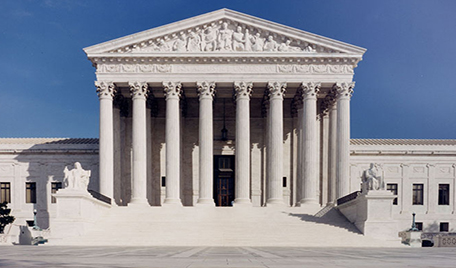 On Aug. 31, 2026, the justices handed down a decision from its emergency docket in National Trust for Historic Preservation v. National Park Service. The majority per curiam unsigned opinion held that the National Trust, a private nonprofit originally chartered by Congress in 1949, lacked standing to challenge the ballroom project in court. The Supreme Court’s opinion in August stayed, or paused, a lower court decision, affirmed by a federal appeals court, that the White House lacked the ability to build the new ballroom on its own.
Now, Solicitor General John Sauer wants the issue resolved by the Supreme Court in one of two ways. In his petition to the Court, Sauer has asked the justices to summarily reverse the lower court decision or accept the case for full arguments at the Court, so the justices may consider the case on its merits.
The Case’s Path to the Supreme Court
The federal government started a project to replace the White House’s East Wing and build a large ballroom and facility to replace it in October 2025. The first part involved demolishing the former East Wing. In March 2026, the National Trust filed a lawsuit in federal district court challenging the project and seeking to stop the construction of a new building above ground on the site. The district court issued a preliminary injunction, but the appeals court stayed the injunction, allowing the project to continue into August 2026.
In an opinion from the U.S. Court of Appeals for the District of Columbia Circuit, Judges Patricia Millett and Bradley Garcia affirmed the district court's preliminary injunction. They held that the administration could not build the privately funded, above-ground White House ballroom without congressional approval.
Judges Millett and Garcia also concluded that the “construction of the ballroom will inflict permanent and irreversible harm to the historic, architectural, and aesthetic interests of the National Trust’s members, as well as the design of President’s Park, the White House, and the surrounding area.”
In her dissent, Judge Naomi Rao countered that “the President has determined the ballroom is necessary for the overall security of the White House as well as to provide a secure space for hosting large presidential events.” Judge Rao said the ballroom project was also likely within the president’s authority to make improvements to the Executive Residence at the White House.
Rao also determined that the National Trust lacked standing to sue the administration. “The district court had no jurisdiction because the Trust has no standing to stop construction at the White House,” she held. “The district court elevated the aesthetic displeasure of a single passerby over the government’s security interests in the ballroom and the security risks of leaving an open construction site at the President’s home and office,” she noted.
The Supreme Court’s Emergency Docket Decision
The August emergency docket decision focused on the Article III concept of standing, where the National Trust needed to establish that it had suffered an injury in fact from the East Wing ballroom project; the injury was traceable to actions of the Trump administration; and the injury could be addressed by a judicial decision.
The Supreme Court majority said the National Trust failed those tests. “The government is likely to prevail in showing that the Trust lacks standing to challenge the East Wing project,” the majority determined. On Aug. 7, 2026, a divided U.S. Court of Appeals for the District of Columbia panel reached the opposite conclusion before the case was appealed to the Supreme Court’s emergency docket. The appeals court held that a Trust member, Alison K. Hoagland, had proven she was harmed by the ballroom’s construction, and that the National Trust had standing to sue on behalf of its members.
Chief Justice John Roberts wrote a dissenting opinion joined by Justices Elena Kagan, Sonia Sotomayor, and Ketanji Brown Jackson. Roberts said the ballroom project was likely unlawful because the project required congressional approval. “The ballroom is a building or structure being erected on federal park grounds—President’s Park—in the District of Columbia. Yet Congress has not passed any law resembling ‘express authority’ for the Executive’s construction of it,” he noted.
Roberts also said the Court’s majority incorrectly applied the standing test to the National Trust. “Given the distinctive nature of the White House and Hoagland’s focused and substantiated interest in viewing it in its traditional form, her aesthetic injury from the construction of the ballroom is concrete and particularized.”
The Solicitor General Wants the Issue Resolved
In his petition of certiorari to the Court, Solicitor General Sauer argues the emergency docket decision almost definitively decided presented question in his opinion. “In staying the district court’s preliminary injunction, and in issuing a detailed per curiam opinion ex-plaining the basis for that stay, this Court has all but answered the question presented,” he states. The question Sauer is presenting to the Court is “[w]hether the district court erred in enjoining the on-going renovation of the East Wing at the White House.”
“The Court held that the ‘government has established that it is likely to succeed on the merits of a significant legal question, that it would likely suffer irreparable harm without a stay, and that the balance of equities tips in its favor,’” Sauer notes. However, the case was not fully argued in front of the justices as part of the emergency or interim docket.
“To be sure, this Court’s stay decisions only involve a preliminary look at the merits and equities,” Sauer acknowledges, but he also believes a “full-blown merits review serves little purpose.” At a minimum, the Solicitor General wants the Court to accept the case to settle the question.
The National Trust has been asked by the Court to respond to the government position by Dec. 7, 2026. It will likely highlight Chief Justice Roberts’ dissenting opinion that the ballroom project needed congressional approval. In considering cases to be accepted by the Court, only four justices are needed at private conference to grant arguments.
Scott Bomboy is the editor in chief of the National Constitution Center.