

Last week, the Supreme Court declined to reconsider parts of its landmark Tinker decision about free speech rights for public school students. And Monday, it took similar action in a dispute about student clubs posting political message flyers in public schools.
 On June 8, 2026, the justices denied a petition for review in C. S. v. Craig McCrumb, a case that asked the justices to rule on what counted as an appropriate clothing choice for a Michigan elementary school student inside of the classroom.
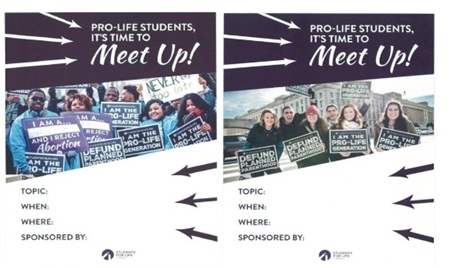
One week later, in E.D. v. Noblesville School District, the Court denied a request from a student who wanted to post flyers for her school club, Noblesville Students for Life. The flyers included photos that showed students objecting to Planned Parenthood. The school prohibited the signs on the grounds that they violated its neutral-content policy and presented a political message that could be confused with the school’s own speech.
A district court agreed with the Noblesville School District that the Supreme Court’s precedent in Hazelwood School District v. Kuhlmeier (1988) applied and that the walls within the school were limited public forums that could be regulated by educators. The U.S. Court of Appeals for the Seventh Circuit upheld the lower court decision and said the Hazelwood precedent gave schools “a broad pedagogical duty to create a stable, neutral educational environment.”
In their petition for a writ of certiorari, the student’s lawyers told the Court that three different federal circuits had been split on the issues presented in the case, and that E.D.’s free speech rights were restricted. The Court declined to hear the case, but Justice Samuel Alito, with his dissent from denial of certiorari, asked the Supreme Court to reconsider Hazelwood in the context of government speech issues.
The First Amendment precedents in question
In 1988, the Supreme Court in Hazelwood defined the authority of educators over school-sponsored publications that students, parents, and members of the public “might reasonably perceive to bear the imprimatur of the school.” In comparison, another well-known free speech precedent, Tinker v. Des Moines Independent Community School District (1969), defined the powers of such educators to silence a student’s personal expression occurring within the school’s premises.
In his majority opinion for a 7-2 Court in Tinker, Justice Abe Fortas held that silent protests—such as wearing armbands—were constitutionally permitted. “It can hardly be argued that either students or teachers shed their constitutional rights to freedom of speech or expression at the schoolhouse gate.” However, Fortas noted that students’ free speech rights didn’t extend to conduct that “materially disrupts classwork or involves substantial disorder or invasion of the rights of others.”
The Court faced a different question in Hazelwood. In 1983, a school principal banned articles from a student newspaper discussing divorce and teenage pregnancy. The editors of the school newspaper brought a First Amendment challenge to the principal’s actions.
Writing for the majority in Hazelwood, Justice Byron White distinguished Tinker from his decision. “The question whether the First Amendment requires a school to tolerate particular student speech—the question that we addressed in Tinker—is different from the question whether the First Amendment requires a school affirmatively to promote particular student speech.”
White said that “a school need not tolerate student speech that is inconsistent with its basic educational mission, even though the government could not censor similar speech outside the school.” He added that the school could censor the student newspaper as long as the decision was “reasonably related to legitimate pedagogical concerns.”
The Tinker and Hazelwood precedents are often considered by courts along with a third precedent, Bethel School District v. Fraser (1986). In Bethel, the Supreme Court determined that public school students cannot claim First Amendment protection for using vulgar language on school grounds. “Under the First Amendment, the use of an offensive form of expression may not be prohibited to adults making what the speaker considers a political point, but it does not follow that the same latitude must be permitted to children in a public school,” said Chief Justice Warren Burger in the majority decision.
The controversy at Noblesville
In their petition to the Court, the attorneys for E.D. were not questioning the Hazelwood precedent, but they challenged how the Seventh Circuit applied the test, arguing that the Seventh’s Circuit’s approach was in conflict with the approach of other circuit courts.
The attorneys noted that the Noblesville Students for Life club was one of many student-led noncurricular clubs approved by the school and that a written policy did not exist regulating the content of flyers posted by these clubs in common areas.
The attorneys believed that the Hazelwood precedent only applied to school-sponsored curricular speech. Using a narrow understanding of Hazelwood, two other federal circuits would have permitted the flyers, while three other circuits (including the Seventh) would have regulated student speech outside the school curriculum, they noted.
“Public-school students in the Fifth, Seventh, and Tenth Circuits have vanishingly small speech rights because any speech that a school allows can be cast as speech that appears school sanctioned. Under that test, even Tinker itself would come out differently,” they concluded.
The Seventh Circuit took a different view. “The record shows that school officials approved E.D.’s club, reasonably accommodated her speech, and suspended the club only for neutral, conduct-related reasons,” it held. One primary consideration was the Hazelwood forum test.
“Because of where and how E.D. sought to display her flyers, they could reasonably be perceived as bearing the school’s imprimatur. If posted, the flyers would have appeared on school walls alongside announcements for school-sponsored events and remained in common areas for days,” the judges reasoned. The Seventh Circuit also said that “the district’s restriction on political content in student flyers is reasonably related to legitimate pedagogical concerns.”
Justice Alito’s dissent from denial
The Supreme Court considered E.D.’s petition nine times in private conference until it denied the petition for a writ of certiorari on June 15, 2026.
In a dissent from denial of certiorari, Justice Alito argued that the Supreme Court needed to define applications of the Hazelwood precedent in the decades following its original decision. “Since Hazelwood was decided, lower courts have struggled to ascertain its precise limits, and in my view, clarification by this Court is in order.”
Alito was specifically worried about how the lower courts defined government speech. “The distinction between private speech and government speech is critical because the Free Speech Clause of the First Amendment constrains censorship of the first category only.”
He also quoted his own majority opinion in Pleasant Grove City v. Summum (2009), where Alito voiced concerns that “the government speech doctrine not be used as a subterfuge for favoring certain private speakers over others based on viewpoint.”
“When Hazelwood was decided, this Court’s decisions had never even mentioned the term ‘government speech,’” he noted.
For now, the denials for certiorari leave the Tinker and Hazelwood precedents and their recent interpretations intact.
Scott Bomboy is the editor in chief of the National Constitution Center.