



President Donald Trump’s recent talk of potentially acquiring Greenland has sparked a new debate about questions that pre-date the Constitution: the ability of the United States to annex territories.
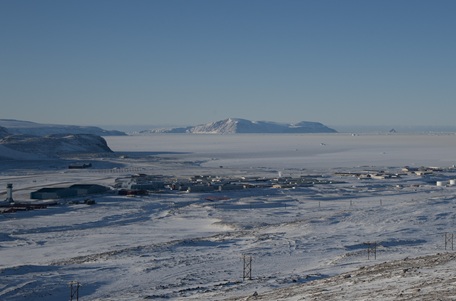 Last Wednesday, Trump told global economic leaders gathered in Davos, Switzerland, that he wanted “immediate negotiations to once again discuss the acquisition of Greenland by the United States.” He added that the Unites States would not use force to acquire Greenland, which is an autonomous territory of the Kingdom of Denmark. Later, Trump said he was negotiating with NATO over the Greenland question.
The debate over Greenland has led to a review of past instances when the United States added territorial possessions. Since the time of the nation’s founding in 1776, the Senate has approved treaties with countries after armed conflicts or peaceful negotiations. In other cases, joint resolutions of Congress led to the annexation of territories.
Early Annexation Issues
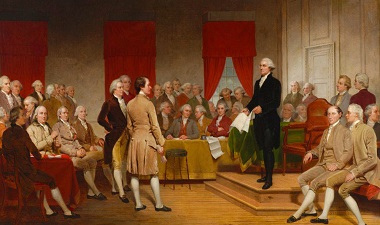
The annexation issue was first addressed in the Articles of Confederation. The Articles approved in November 1777 and ratified by the states in 1781 included Article XI, which read that “Canada acceding to this confederation, and adjoining in the measures of the United States, shall be admitted into, and entitled to all the advantages of this Union.” The annexation of Canada became a moot point during the 1780s, and it was not mentioned during the Constitutional Convention of 1787 in Philadelphia.
The Northwest Ordinance passed by the Continental Congress in July 1787 established a framework for administering territorial acquisitions. In this case, the Northwest Territory was land ceded to the United States from Great Britain in the Treaty of Paris in 1783. Although it contained language that “the utmost good faith shall always be observed towards Indians,” lands occupied by Native Americans were annexed or occupied in the ordinance’s aftermath.
The Constitution contained several provisions about how new territories added to the United States would be regulated. Article IV, Section 3 defined the process of admitting new states. It also gave Congress the power “to dispose of and make all needful Rules and Regulations respecting the Territory or other Property belonging to the United States.” But there was no direct language about how the federal government could annex territories.
The independent republics of Vermont in 1791 and Kentucky in 1792 became states through annexation under Article IV when they applied for statehood. Tennessee was the first territory to go through the full territorial statehood process.
The Louisiana and Texas Precedents
Among the most controversial property acquisitions came a decade later, when James Monroe and Robert R. Livingston traveled to France in 1803 to negotiate the Louisiana Purchase. Napolean Bonaparte, in need of funds for a pending war with Britain, surprised the American envoys by offering France’s entire southern territory for sale. When the news reached President Thomas Jefferson, he was concerned that the Constitution did not explicitly grant the federal government the power to buy foreign territory.
Listening to his advisers (including James Madison), Jefferson proceeded with a treaty enabling the sale. Under Article II, Section 2, the president has the “Power, by and with the Advice and Consent of the Senate, to make Treaties, provided two thirds of the Senators present concur.” The Senate passed the treaty over the objections of the Federalists. In 1823, Chief Justice John Marshall in American Insurance Co. v. Canter made it clear the federal government could acquire foreign properties. “The Constitution confers absolutely on the government of the Union, the powers of making war, and of making treaties; consequently, that government possesses the power of acquiring territory, either by conquest or by treaty,” Marshall wrote.
The acquisition of Texas presented another situation related to the annexation of foreign property. After Texas became an independent republic in 1836, it sought admission to the United States. The Tyler administration presented a Treaty of Annexation to the Senate that was rejected in April 1844, which also angered Mexico. In March 1845, Tyler worked with President-elect James Knox Polk to have Texas successfully admitted as a state using a joint resolution of Congress, which only required simple majority votes. The move was criticized by some as exceeding the powers granted to Congress under the Necessary and Proper Clause of Article1, Section 8.
The Hawaii Controversy
In the following years, the United States acquired extensive properties from Mexico as part of the Treaty of Guadalupe Hidalgo in 1848 that ended the armed conflict between the two nations, and it bought Alaska from Russia in 1867 for $7.2 million. Its later acquisition of Hawaii presented some of the same issues involved in the annexation process related to Texas.
By 1875, the independent kingdom of Hawaii had become increasing economically dependent on trade with the United States due to a reciprocity treaty. Soon, American planter interests in the sugar trade played a dominant role on the islands. In 1888, American planters forced King David Kalakaua to relinquish his powers with a revised constitution. However, tariffs led to falling sugar prices in 1890, and the planters engineered a coup backed by a U.S. warship to remove Queen Liliuokalani in 1893. Sanford Dole became president of the new Republic of Hawaii, which applied for annexation as a United States territory. President Benjamin Harrison’s proposed annexation treaty was not considered by the Senate and incoming President Grover Cleveland deeply opposed the treaty and the removal of Queen Liliuokalani.
President William McKinley pressed for Hawaii’s annexation, but McKinley failed in 1897 to have Hawaii annexed using the Senate treaty and joint resolution processes. With war against Spain declared in 1898, the House and Senate passed a joint resolution to annex Hawaii as a territory, with Hawaii assuming full territorial status in 1900. Subsequently, the United States acquired the Philippines, Puerto Rico, and Guam from Spain through the Treaty of Paris.
A Treaty with Denmark
The last major territorial acquisition by the United States occurred in 1916 amid World War I. The United States government had been in secret talks to acquire the Danish West Indies. The Senate approved a treaty in September 1916 to take over St. Croix, St. John and St. Thomas from Denmark at a cost of $25 million. President Woodrow Wilson signed the final agreement in January 1917, with the territory renamed as the United States Virgin Islands.
In signing the initial treaty agreement with Denmark, Secretary of State Robert Lansing agreed “that the Government of the United States of America will not object to the Danish Government extending their political and economic interests to the whole of Greenland.”
However, subsequent years the United States became interested in acquiring Greenland. According to historian Ron Doell, in his book Exploring Greenland: Cold War Science and Technology on Ice, “The USA sought repeatedly (although unsuccessfully) to purchase Greenland from Denmark as the Cold War began, irritating and worrying Danish citizens and their leaders,” citing declassified top-secret memos. One offer came directly from Secretary of State James Byrnes in 1946. The offers required full United States sovereignty over Greenland. Danish leaders refused to consider a sale.
Scott Bomboy is editor in chief of the National Constitution Center.