
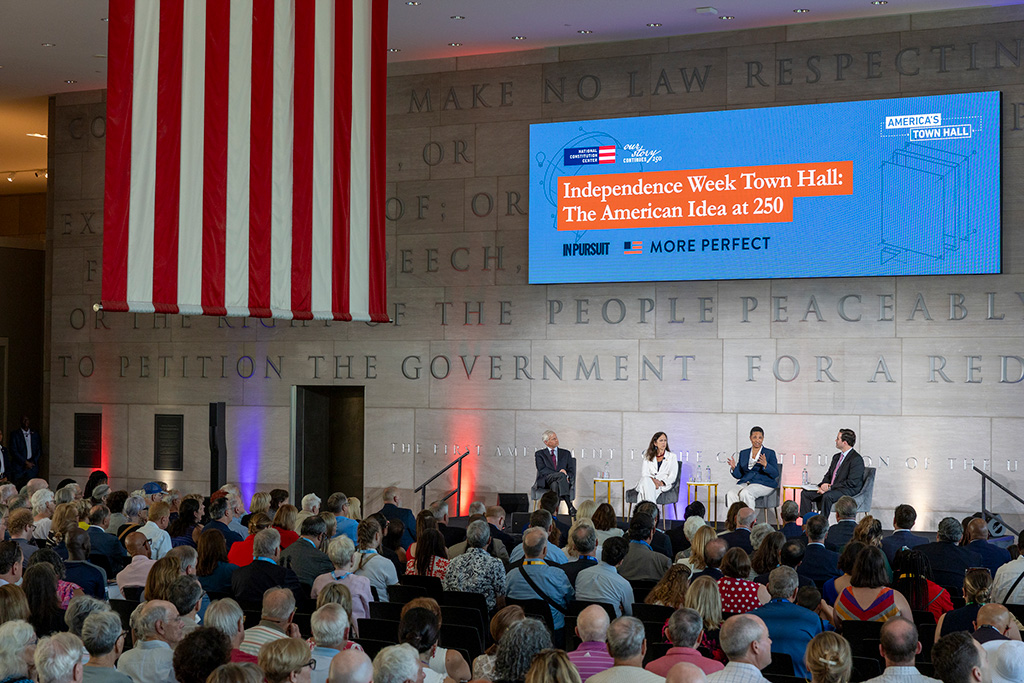
In the wake of Philadelphia magazine's controversial cover story “Being White in Philly,” the magazine joins the National Constitution Center to present a program about the story and how to foster productive, thoughtful conversations about race-related issues in Philadelphia. Philadelphia magazine editor Tom McGrath moderates a conversation featuring Robert Huber, author of the cover story; Dr. Walter Palmer, lecturer at the University of Pennsylvania; Solomon Jones, best-selling author and award-winning journalist; Farah Jiminez, president and CEO of the People's Emergency Center; and journalist Christopher Norris.
May 16, 2013
A Nation Divided: The Second Amendment After Newtown
The National Constitution Center and WHYY present a timely town hall discussion about Second Amendment freedoms and the tension between gun control and gun rights in 21st-century America. The conversation features E. Duncan Getchell, solicitor general of Virginia, and R. Seth Williams, district attorney of Philadelphia. Dave Davies, a senior reporter for WHYY and a contributor and guest host for Fresh Air with Terry Gross, moderates.
May 16, 2013
Gavin Newsom: Government in the Digital Age
Join California Lieutenant Governor Gavin Newsom as he discusses his newly released book, Citizenville: How to Take the Town Square Digital and Reinvent Government—a guide for how ordinary citizens can use technology and social media to transform American democracy. Renowned as a political, digital, and entrepreneurial pioneer, Lieutenant Governor Newsom served two terms as the youngest mayor of San Francisco—where he granted marriage licenses to same-sex couples and fostered the city’s growth as a center for technology. The conversation will be moderated by Philadelphia Mayor Michael A. Nutter.
April 12, 2013
The 10th Annual Templeton Lecture: The Moral Case for Economic Liberty
On the heels of the final debate of the presidential election, the 10th Annual Templeton Lecture on Economic Liberties and the Constitution delves into the key issue of economic freedom through the lens of Founding Fathers (and authors of The Federalist Papers) Alexander Hamilton, John Jay, and James Madison. This compelling conversation features American Enterprise Institute President Dr. Arthur C. Brooks, author of the New York Times bestseller The Road to Freedom: How to Win the Fight for Free Enterprise, and National Review Senior Editor Richard Brookhiser, an eminent historian who will provide expert insight into America’s early economic ideals. The John M. Templeton Jr. Lecture showcases the best constitutional minds in America as they discuss economic liberties in a forum open to the public.
April 12, 2013
Hail to the Chiefs (of Staff)
Every powerful elected official in America depends on a smart, savvy, and highly skilled chief of staff. Get an insider’s look at campaigns, elections, and the trials of governing at this must-see panel discussion with current and former chiefs of staff including Matthew Gallagher (Maryland Governor Martin O'Malley), Anita McBride (former First Lady Laura Bush) and David Urban (former Senator Arlen Specter). Scott Detrow of NPR’s StateImpact PA project moderates.
April 12, 2013
Akhil Amar: America’s Unwritten Constitution
Despite its venerated place in American history, the U.S. Constitution may not enumerate all of the various rules, rights, principles, and procedures that guide America's political system. Join renowned constitutional scholar and Yale Law Professor Akhil Amar to explore the little-understood relationship between the written Constitution and the many traditions, practices, standards, and sources that shape our interpretation of it. In his latest book, America's Unwritten Constitution: The Precedents and Principles We Live By, Professor Amar illuminates the complementary relationship between the Constitution's written and unwritten components—one of America's greatest and most enduring strengths. Dr. Francis Graham Lee moderates.
September 21, 2012
Is the World Rejecting American Constitutionalism?
Most Americans revere their Constitution, but what does the rest of the world think? Leading scholars—Professors Richard Beeman, David Law, Akhil Amar, and David Armitage—participate in a timely discussion on the global influence and relevance of the U.S. Constitution.
September 20, 2012
Robert Draper: Inside the 112th Congress
Celebrated journalist and bestselling author Robert Draper joins the Center for a revealing, riveting look inside the 112th Congress, the focus of his forthcoming book Do Not Ask What Good We Do: Inside the U.S. House of Representatives. Paul Kane of The Washington Post moderates this timely conversation.
May 14, 2012
Equality Forum: LGBT Rights and the 2012 Election—PART 2
In partnership with Equality Forum, the National Constitution Center hosted two compelling, back-to-back conversations exploring the pressing legal and political issues at stake for lesbian, gay, bisexual and transgender Americans in the 2012 election. The second session analyzed the political landscape as it relates to LGBT civil rights. What are the key races and who are the candidates to watch? Will LGBT rights divide our political parties in the future? This conversation was moderated by Chuck Wolfe, president and CEO of Gay & Lesbian Victory Fund, and features Andrew Tobias, treasurer of the Democratic National Committee, R. Clarke Cooper, executive director of the Log Cabin Republicans, Patrick Guerriero of Civitas Public Affairs Group, and Rebecca Isaacs, executive director of Equality Federation.
May 04, 2012
Equality Forum: LGBT Rights and the 2012 Election—PART 1
In partnership with Equality Forum, the National Constitution Center hosted two compelling, back-to-back conversations exploring the pressing legal and political issues at stake for lesbian, gay, bisexual and transgender Americans in the 2012 election. In the first session, speakers addressed the political fate of Prop 8; the Defense of Marriage Act; the Employment Non-Discrimination Act (ENDA); and how the repeal of “Don’t Ask, Don’t Tell” impacted the LGBT community. The conversation was moderated by Jennifer C. Pizer, legal director for the Williams Institute at UCLA’s School of Law, and features William Eskridge of Yale University, Katherine Franke of Columbia University, Hayley Gorenberg of Lambda Legal, and Janson Wu of Gay & Lesbian Advocates & Defenders.
May 04, 2012
Amy Gutmann and Dennis F. Thompson: The Spirit of Compromise
Will members of Congress change their minds about compromise, or do voters need to change the members of Congress? Eminent political thinkers Amy Gutmann and Dennis F. Thompson speak with NBC’s Andrea Mitchell about their forthcoming book The Spirit of Compromise: Why Governing Demands It and Campaigning Undermines It, which explores whether government leaders can overcome partisan divides for the benefit of all citizens.
May 02, 2012
Social Media: The New Political Battleground
The 2012 presidential race is arguably the first to fully reflect a major political shift to the digital world. Will candidates who don’t show up on this digital playing field be left in the dust? Political strategists and social media/technology experts Maria Cardona, Andrew Rasiej, Daniel Sieberg, Alex Torpey, and Todd Van Etten take a hard look at the role of social media and its impact on the 2012 presidential campaign. Jonathan Capehart of The Washington Post moderates.
April 19, 2012
Joseph J. Ellis on the First Family: Abigail and John Adams
Joseph J. Ellis, the Pulitzer Prize-winning, bestselling author of Founding Brothers: The Revolutionary Generation and His Excellency: George Washington, discusses his latest book, First Family: Abigail and John Adams. Ellis brings America’s preeminent first couple to life and illuminates their unique partnership during the American Revolution and the nation’s tenuous early years. Dr. Richard R. Beeman moderates.
April 12, 2012
Left and Right: Rendell and Whitman on Election 2012
In the midst of the 2012 presidential race, former Governors Ed Rendell and Christine Todd Whitman offer contrasting perspectives and firsthand knowledge of the election’s key players and issues, from immigration to the economy. With only two weeks before Pennsylvanians vote, Rendell and Whitman shared their opinions on the caucus and primary system and how it is working for their respective states. David Eisner, president and CEO of the National Constitution Center, moderates.
April 09, 2012
A Conversation with Senator Arlen Specter
Former Pennsylvania Senator Arlen Specter shares insights from his compelling new memoir, Life Among the Cannibals, and provides an insider's look at the growing partisan divide in Washington and on the campaign trail. Mike Castle, former member of Congress and governor of Delaware, moderates.
April 02, 2012
Practically Speaking: Transportation in a Time of Political Gridlock
The budget crisis and ongoing policy debates in Washington, D.C., have a profound impact on state and local governments and citizens. In this climate of gridlock and partisanship, how do politicians and policy experts create and implement a transportation strategy for the 21st century? Practically speaking, it’s a matter of federalism. Joining the Center for this conversation are Peter J. “Jack” Basso, chief operating officer of AASHTO; Joshua L. Schank, president and CEO of Eno Transportation Foundation; James S. Simpson, chairman of NJ TRANSIT; and Martin Wachs, senior principal researcher at RAND. David Thornburgh, executive director of the Fels Institute of Government, moderates.
With the American economy still struggling and taxpayers in the toughest position in generations, taxes and tax reform is one of the key issues in the 2012 presidential election. What will work and what won’t—voters need to be informed to decide. Rich Lowrie, who served as Herman Cain’s economic advisor during his recent White House bid and was co-author of the controversial 9-9-9 plan, joins White House veteran Bruce Bartlett and economics professor Rosanne Altshuler for a lively and important conversation. David Eisner, president and CEO of the National Constitution Center, moderated this program on February 7, 2012.
February 07, 2012
Cullen Murphy: God’s Jury: The Inquisition and the Making of the Modern World
Vanity Fair editor Cullen Murphy discusses his new book, God’s Jury: The Inquisition and the Making of the Modern World, taking us from the musty Vatican archives to the detention cells of Guantanamo; from the heretical fortresses of medieval France to the burning of books in modern Florida; from the torture chambers of the Spanish Inquisition to the file cabinets of the East German secret police; and from the streets of colonial Santa Fe to the inner sanctums of the White House. Murphy argues that when you look at the Inquisition, what you really see is the beginning of the struggle for freedom in the modern world. James B. Steele, contributing editor for Vanity Fair, facilitated this discussion on January 24, 2012.
What Would the Founding Fathers Think of Facebook?
Privacy expert and author Lori Andrews, Forbes blogger Kashmir Hill, and New York Times reporter Jennifer Preston join the National Constitution Center to speak about how the Founding Fathers might have handled online social networks. What would happen if social networking sites were subject to the Bill of Rights? With 750,000,000 members, Facebook is the third largest nation in the world; should it have a Constitution? If so, what rights and responsibilities should be included? Christopher Wink, co-founder of Technically Philly, moderates this discussion from January 12, 2012.
In her highly anticipated book, The Obamas, New York Times reporter Jodi Kantor provides an insider’s perspective on Barack and Michelle Obamas' experiences as president and first lady -- raising children, maintaining friendships and being the first African-American “first couple” to occupy the White House. Filled with riveting detail, humor, emotional and psychological depth, and keen insights on the ironies of public life, The Obamas is an intimate portrait that will surprise even readers who thought they understood America’s most famous pair. Alison Young, Vice President of Public Engagement at the National Constitution Center, facilitates the discussion which took place on January 18, 2012.
MSNBC's Hardball host and bestselling author Chris Matthews joins nationally syndicated radio host Michael Smerconish in conversation about his new book, Jack Kennedy: Elusive Hero. By following the journey of President Kennedy’s life from his school days to the White House, through his toughest trials and greatest triumphs, Matthews brings us much closer to the man Kennedy really was. Program recorded on 11/3/11.
Tony Horwitz: Midnight Rising: John Brown and the Raid that Sparked the Civil War
In his latest book, Midnight Rising: John Brown and the Raid that Sparked the Civil War, bestselling author Tony Horwitz explores the electrifying tale of the daring insurrection that put America on the path to civil war. In this discussion Horwitz shares Brown's uprising in vivid color, revealing a country on the brink of explosive conflict. Judith Giesberg, Associate Professor of History at Villanova University, facilitates the conversation. Program recorded on 11/3/11.
The current term of the U.S. Supreme Court, which opened Monday, October 3, is expected by many observers to be the most challenging in years. Lyle Denniston, veteran Supreme Court correspondent and the Center’s Advisor on Constitutional Literacy, and John Payton, President and Director-Counsel of the NAACP’s Legal Defense Fund, discuss the controversies already on the docket. Program recorded on 09/29/11.
James Madison led one of the most influential and prolific lives in American history. Although often overshadowed by his more celebrated contemporaries, Madison helped to shape our country as perhaps no other Founder did. Eminent historian Richard Brookhiser joins Michael C. Quinn, president of the Montpelier Foundation, to discuss his newly released book about the “Father of the Constitution,” an accomplished yet humble statesman who nourished Americans’ fledgling liberty and vigorously defended the laws that have preserved it to this day. This program is presented in partnership with James Madison's Montpelier. Program recorded on 10/11/11.
Award-winning Washington Post reporter Dana Priest joins the Center to discuss her new book, Top Secret America, and the size, shape, mission and consequences of the universe of over 1,300 government facilities in every state in America; nearly 2,000 outside companies used as contractors; and more than 850,000 people granted "Top Secret" security clearance in response to the 9/11 terrorist attacks. Program recorded on 9/12/11.
In a special program at the National Constitution Center, featuring questions from a live audience and those submitted via Twitter, 2011 Liberty Medal recipient and former Defense Secretary Robert M. Gates spoke about a range of subjects–from the future of the military, to the status of Middle East diplomacy, to the repeal of the Don’t Ask, Don’t tell policy. The conversation with Dr. Gates, which took place before an invited audience that includes ROTC cadets from St. Joseph’s University and the University of Pennsylvania, was moderated by David Eisner, President & CEO of the Center. Program recorded on 9/22/11.
As the birthplace of America, and the city where the Declaration of Independence and the U.S. Constitution came to life, Philadelphia has a longstanding legacy of liberty. This program, presented in partnership with the Greater Philadelphia Roundtable, invites public participation in considering Philadelphia's history and experiences as a "Cradle of Liberty." Moderated by Richard Beeman of the University of Pennsylvania, this program features Gary Nash of the University of California, Los Angeles; Michael Coard of Avenging the Ancestors Coalition; and Richard Newman of the Rochester Institute of Technology. Friends of Independence and Avenging the Ancestors Coalition co-sponsored this event. Program recorded on 6/23/11.
As the Supreme Court of the United States concluded its 2010-2011 session, the National Constitution Center welcomed veteran Supreme Court correspondent Lyle Denniston to give a lunchtime talk about the most significant rulings of the term and how these decisions impact the lives of Americans. He also analyzed how the Court's new justices have changed the institution. Program recorded on 7/6/11.
9th Annual Templeton Lecture: Competition and the Constitution
The Ninth Annual John M. Templeton, Jr. Lecture on Economic Liberties and the Constitution considers how the Constitution addresses government regulation and relies on competition as a method of political organization. Keynote speaker Christopher DeMuth, D.C. Searle Senior Fellow at the American Enterprise Institute for Public Policy Research, explores the laws and regulations that can inhibit economic liberty and examine the boundaries between the Constitution’s explicit and implicit guarantees of competition, which have been contested throughout our political history. Michael L. Wachter, William B. Johnson Professor of Law and Economics and Co-Director, Institute for Law and Economics at the University of Pennsylvania, provides the response to Mr. DeMuth's presentation. Daniel Gross, economics editor and columnist at Yahoo! Finance, facilitated the conversation. Program recorded on 6/16/11.
Thomas E. Mills, Acting Deputy Archivist of the United States, joins The Philadelphia Inquirer’s Bill Marimow for a conversation about issues of government transparency, state secrets, classification and access to government documents and information. How transparent should government be? Can there be limits in our democracy on citizens’ right to information? Is access to information a right? What can citizens do to make the government more open with its information and resources? Program recorded on 5/3/11.
1861: The Civil War Awakening, Adam Goodheart’s new book, is an epic of courage and heroism beyond the battlefields. Marking the sesquicentennial of the start of the Civil War, Goodheart joined the Center to share the gripping account of how the Civil War began. Dr. Richard R. Beeman, the John Welsh Centennial Professor of History at the University of Pennsylvania, facilitated the conversation. Program recorded on 4/13/11.
Is there a conflict between national security and civil liberties? Fox 29’s Vice President and General Manager Patrick Paolini moderates a discussion on the challenge of securing our nation while maintaining our constitutional balance in times of crisis. Former National Security Advisor and National Constitution Center Visiting Scholar Richard Allen and University of Pennsylvania Law professor Deborah Pearlstein share their experience. This program is a special presentation in partnership with the University of Pennsylvania Law School, and in conjunction with the Center's exhibition, Spies, Traitors & Saboteurs: Fear and Freedom in America. Program recorded on 5/09/11.
Can We Talk? A Conversation About Civility and Democracy in America
Former U.S. Representative Lee H. Hamilton (D-IN), John G. Palfrey, Jr., Professor of Law and Vice Dean for Library and Information Resources at Harvard Law School, and Keli A. Carender, political activist and blogger credited with starting the Tea Party movement, discuss the future of civility in our democracy in the midst of our nation's ongoing debate about the inflamed state of political discourse. This program is presented as part of “Can We Talk? A Conversation about Civility and Democracy in America,” partially funded by the National Endowment for the Humanities’ Bridging Cultures program. Program recorded on 3/26/11.
The National Constitution Center and PBS hosted an advanced look at the upcoming documentary film, “Prohibition,” directed by Ken Burns and Lynn Novick, scheduled to air on PBS this coming fall. The screening of highlights from the film and audience Q&A represented the opening event of “Can We Talk? A Conversation about Civility and Democracy in America” that took place at the Center March 25 through March 27, 2011 with support from the National Endowment for the Humanities. Program recorded on 3/25/11.
More and more, Americans are driven to careers that connect us to the social challenges of our time. How are we shifting from jobs to “encore careers” that embrace civic engagement? Renowned social entrepreneur Marc Freedman addresses these issues as he kicks off his book tour at the Center in support of The Big Shift. In a conversation with National Constitution Center President and CEO David Eisner, Freedman discusses the challenge of transitioning to and making the most of this new stage, which he believes is an urgent social imperative. He urges people to rethink their civic connections and to do work that matters, helping Americans realize the vision of the founders – an engaged citizenry. Program recorded on 4/5/11.
Putting the 14th Amendment to the Test explores whether the language of the 14th Amendment should be modified, left in its present state, or reinterpreted to deny citizenship to the children of illegal immigrants. Jeff Greenfield, senior political correspondent for CBS News, moderates this timely program addressing the issue of immigration reform and birthright citizenship with Fellows of the Peter Jennings Project and distinguished guests John C. Eastman, Daryl Metcalfe, Jorge Mursuli, Marjorie Rendell, and Cecillia Wang. Program recorded on 3/5/11.
WPHT Talk Radio 1210 AM’s Dom Giordano and National Constitution Center President and CEO David Eisner hosted this live, public forum on the priorities for the 112th Congress with members of the U.S. House Chaka Fattah (D-PA/2), Mike Fitzpatrick (R-PA/8), Jim Gerlach (R-PA/6), Pat Meehan (R-PA/7) and John Runyan (R-NJ/3). Program recorded on 2/21/11.
Marking the first stop on his highly-anticipated national book tour, former Defense Secretary Donald Rumsfeld joins the National Constitution Center for a conversation with historian Michael Beschloss about previously undisclosed details and insights about the Bush administration, 9/11, and the wars in Afghanistan and Iraq. The discussion also draws on the themes from Rumsfeld's new memoir which chronicles his long career in public service, including his four terms in Congress and his service in the administrations of Richard Nixon, Gerald Ford and George W. Bush. Program recorded on 2/09/11.
The National Constitution Center presents best-selling author Dan Okrent in a conversation with CEO David Eisner about his new book, Last Call: The Rise and Fall of Prohibition, which tells the fascinating history of Prohibition and its broader constitutional implications. Detailing the political forces that organized to pass the law, Okrent provides an engaging account of how Prohibition got started, its impact on the lives of everyday Americans, and the eventual swell of public support that led to the only constitutional amendment to ever be repealed. Program recorded on 12/06/10.
The National Constitution Center presents TIME managing editor, Richard Stengel, in a conversation about the 21st Century through the lens of TIME: The Illustrated History of the World’s Most Influential Magazine. Stengel also discusses the current state of media and his tenure as the leader of the Center from 2004-2006 with David Eisner, current President & CEO. Program recorded on 12/02/10.
The National Constitution Center’s newly appointed 2010-11 Visiting Scholar, Richard V. Allen, explores the question “What is national security?” in the first program of a two-part series. Allen is a Senior Fellow at the Hoover Institution and served under both Presidents Richard Nixon and Ronald Reagan. Stanley Ridgley, Assistant Professor of Strategic Management and International Business at Temple University’s Fox School of Business, facilitates the discussion. Program recorded on 11/15/10.
The National Constitution Center presents a special Veterans Day, 2010 roundtable conversation about the importance of active citizenship with Alan Khazei, co-founder of City Year and author of the new book Big Citizenship: How Pragmatic Idealism Can Bring Out the Best in America. In a political environment often bogged down by petty bickering and cynicism, Khazei prescribes a way to bridge differences and effect powerful change. Joining Khazei in the discussion is former United States Senator Harris Wofford, Associate Director of the Peace Corps from 1962-1966, and David Eisner, President & CEO of the National Constitution Center and former CEO of the Corporation for National and Community Service. Program recorded on 11/11/10.
The National Constitution Center presents Supreme Court Justice Stephen Breyer for a discussion about his new book, "Making Our Democracy Work: A Judge’s View." Building on his previous book, "Active Liberty," Justice Breyer considers questions that are fundamental to our constitutional system and the future of the Supreme Court. He argues that since the nine members of the Court are not elected, they need to reinforce their institutional legitimacy by pragmatically applying unchanging constitutional values to ever-changing circumstances. Adam Liptak, Supreme Court correspondent for The New York Times, leads the discussion. Program recorded on 10/19/10.
Award-winning historian Ron Chernow discusses his new book, Washington: A Life. This painstakingly researched biography of our nation’s foremost founding father provides readers a greater understanding of Washington’s life and times. With access to previously unseen archival sources, Chernow has developed a richly nuanced account of Washington from his early years as a young firebrand to his later years as America’s first president. Dr. Steve Frank, Chief Interpretive Officer at the National Constitution Center, facilitates the discussion. Program recorded on 10/18/10.
As the Supreme Court begins its new term, the National Constitution Center presents veteran Supreme Court correspondent Lyle Denniston in a conversation with Geoffrey Stone, the National Constitution Center’s 2010-11 Visiting Scholar and Professor of Law at the University of Chicago Law School, and attorney Helgi Walker, partner at Wiley Rein LLP, that addresses the major cases pending for the new term and the potential impact that newly confirmed Justice Elena Kagan will have on the dynamics of the Court. Program recorded on 9/20/10.
The National Constitution Center, in partnership with The Library Company of Philadelphia, presents historian Eran Shalev, author of Rome Reborn on Western Shores, to discuss the literature of America’s revolutionary era, and to assess antiquity's importance to the early political culture of the United States. Rome Reborn examines the extent to which classical antiquity, especially Rome, molded understandings of history, politics, and time, even as the experience of the Revolution reshaped patriots' understanding of the classics. Daniel Richter, Professor of American History at the University of Pennsylvania, moderates. Program recorded on 7/13/10.
Lost Rights: The Misadventures of a Stolen American Relic
Journalist and author David Howard discusses the fascinating story of the disappearance of North Carolina’s original copy of the Bill of Rights. His new book, Lost Rights, follows every twist in that epic passage, from the Indiana businessman who purchased the looted parchment for five dollars to the high-end antiquities dealer who, in 2003, tried to sell it to the National Constitution Center under false pretenses for $5 million. That dubious offer triggered an unlikely series of events that climaxed with a dramatic FBI sting on the 32nd floor of a Philadelphia office tower. Program recorded on 6/29/10.
The National Constitution Center welcomes veteran Supreme Court correspondent Lyle Denniston to lead a discussion with former United States Solicitor General Gregory Garre and NAACP LDF President John Payton about the most significant rulings of the most recent Supreme Court term and how these decisions will impact the lives of Americans. The program also addresses the retirement of Justice John Paul Stevens and the nomination of now confirmed Justice Elena Kagan. Program recorded on 7/8/10.
Jonathan Alter, bestselling author and national political reporter for Newsweek and NBC, provides an inside account of the breakneck speed with which President-elect Obama, and then President Obama, began making critical decisions and assuming the burdens of office amid the greatest economic crisis since the Great Depression. He also explains what the President is like as a person, how he operates, and why he is so insistent on leading the country and the world into a new era of change. Program recorded on 6/22/10.
The National Constitution Center presents bestselling historian and Newsweek Assistant Managing Editor Evan Thomas for a conversation about his new book, The War Lovers, the story of six men at the center of a transforming event in U.S. history and why the Spanish-American war has uncanny resonance today. Sean Wilentz, Professor of History at Princeton University, moderates. Program recorded on 6/1/10.
Rajiv Chandrasekaran, Washington Post editor and author of Imperial Life in the Emerald City, Charles Maier, author of Among Empires and Leverett Saltonstall Professor of History at Harvard University, and Timothy Parsons, author of The Rule of Empires and Professor of African History at Washington University, address issues raised in the Constitution Center's original exhibition Ancient Rome & America. They provide a sweeping account of the evolution of empire from its origins in ancient Rome to its most recent twenty-first century embodiment, explain what constitutes an empire, and offer suggestions about what empires of the past can tell us about our own historical moment. Program recorded on 6/7/10.
Lawrence H. Summers delivers the 2010 Templeton Lecture on Economic Liberties and the Constitution.
Lawrence Summers, Director of the White House's National Economic Council and President Obama’s Chief Economic Adviser, discusses America's economic landscape in a post-recession world, for the National Constitution Center’s Eighth Annual John M. Templeton, Jr. Lecture on Economic Liberties and the Constitution. George L. Priest, Professor of Law and Economics and Kauffman Distinguished Research Scholar in Law, Economics, and Entrepreneurship at Yale Law School, delivers the response. Glenn Hubbard moderates. Program recorded on 5/27/10.
Leaving a Legacy: The Departure and Replacement of Justice John Paul Stevens
Justice John Paul Stevens' legacy and the implications of replacing him on the Supreme Court is the focus of this experts’ roundtable hosted by the National Constitution Center and the University of Pennsylvania Law School. The roundtable of Penn Law School experts includes Cary Coglianese, Deputy Dean and Edward B. Shils Professor of Law and Professor of Political Science; Seth Kreimer, Kenneth W. Gremmil Professor of Law; Deborah Pearlstein, Visiting Faculty Fellow and Lecturer and former clerk for Justice Stevens; Kermit Roosevelt, Professor of Law; and Theodore Ruger, Professor of Law. Michael A. Fitts, Dean and Bernard G. Segal Professor of Law, moderates. Program recorded on 5/6/10.
Revolutionaries: A New History of the Invention of America
On the release of his newest book, Revolutionaries: A New History of the Invention of America, Pulitzer Prize-winner Jack Rakove joins the National Constitution Center to discuss how the country came to be and why the idea of America endures. University of Pennsylvania Professor of History Richard Beeman moderates. Rakove tells the stories of the founders before they were fully formed leaders, as individuals whose lives were radically altered by the explosive events of the mid-1770s. Rakove uses little-known stories of these famous (and not so famous) men to capture--in a way no single biography ever could--the intensely creative period of the republic's founding. Program recorded on 5/11/10.
The National Constitution Center presents a timely conversation with legal scholars Joyce Lee Malcolm and David A. Strauss about one of the most important and controversial cases before the Supreme Court in the 2010 term: the Chicago gun-rights case. At issue in McDonald v. Chicago is whether the right to keep and bear arms is a fundamental constitutional privilege -- like freedom of speech, press and religion – that can be invoked by individuals against the actions of state and local governments as well as the federal government. As the briefs start coming to the Court for the case, a battle is brewing over the so-called "incorporation doctrine," which has applied most, but not all, guarantees of the federal Bill of Rights to state and local governments. The program is moderated by Lyle Denniston. Program recorded on 5/5/10.
The National Constitution Center and the University of Pennsylvania Law School present Visiting Scholar A.E. Dick Howard, White Burkett Miller Professor of Law and Public Affairs at the University of Virginia School of Law, in a lecture on the emergence of global constitutionalism and whether universal norms--such as human rights--ought to apply to constitutions around the world or whether constitutions are ultimately contingent upon a nation's history, traditions, and culture. Program recorded on 4/29/10.
Lee Bollinger, President of Columbia University and one of the nation’s foremost experts on the First Amendment, joins the Center to discuss his book, Uninhibited, Robust, and Wide-Open: A Free Press for a New Century, and to explore the history of a free press in America. Bollinger also sheds light on the meaning of freedom of the press in our globalized, internet-dominated era. Bill Marimow, editor of The Philadelphia Inquirer, moderates. Program recorded on 4/21/10.
A More Perfect Union: Confronting America’s Racial Divide
On the two-year anniversary of then-Senator Barack Obama’s pivotal campaign speech, "A More Perfect Union," Gwen Ifill, moderator and managing editor of "Washington Week" and senior correspondent for "The PBS Newshour," Martin Luther King, III, Founding President and CEO of Realizing the Dream, Inc., and Dr. Thomas J. Sugrue, David Boies Professor of History and Sociology at the University of Pennsylvania, joined the National Constitution Center for an open dialogue on race, moderated by Dr. Charles A. Williams III, assistant clinical professor and director of the Center for the Prevention of School-Aged Violence at Drexel University. Before joining the panel, Dr. Michael L. Lomax, President and CEO of UNCF (the United Negro College Fund), begins the conversation with a presentation proposing that education leads America’s racial priorities. Program recorded on 3/04/10.
The National Constitution Center presents Newsweek International's Maziar Bahari and Dr. Hamid Dabashi, Professor of Iranian Studies at Columbia University, in a conversation moderated by the Philadelphia Inquirer's Trudy Rubin about the growing unrest in Iran and the future of free speech and a free press in the Islamic Republic. This program was presented in conjunction with the Philadelphia Free Library's One Book, One Philadelphia initiative, which chose Marjane Satrapi's "The Complete Persepolis," a memoir of growing up as a girl in revolutionary Iran, as the 2010 featured selection. Program recorded on 3/04/10.
Yale Law School Professor Bruce Ackerman, former Army vice chief of staff General Jack Keane, and Brigadier General H. R. McMaster, join the Center for a timely conversation with moderator Terry Moran of ABC News about maintaining our constitutional balance in a protracted war. If we are indeed in an age of persistent conflict, can we maintain the Constitution’s prized balance of power, or must the executive, in a permanent state of emergency, have expanded power to act without significant participation by Congress or the courts? This program is presented as part of the 2010 Peter Jennings Conference for Journalists and the Constitution. Program recorded on 2/27/10.
Newsweek’s Sana Butler discusses her new book Sugar of the Crop, an account of her ten year odyssey to find and interview the last surviving children of American slaves. Butler discusses how freed slaves raised their children in the years following the end of the Civil War, and details a race against time to crisscross the country to reveal the hopes and dreams of the first generation of free African Americans. Butler reveals what she calls an immigrant mentality black parents carried after 1865 as they believed in the Constitution and the potential of a new America. Program recorded on 2/22/10.
Former Comptroller General of the United States and head of the U.S. Government Accountability Office David M. Walker joins the Center to discuss his important new book, Comeback America: Turning the Country Around and Restoring Fiscal Responsibility. For years, Walker warned Congress–and the Clinton and George W. Bush administrations–that America faced a large and growing fiscal imbalance due largely to known demographic trends and rising health care costs. Unfortunately, the numbers have gotten worse and our fiscal gap has grown dramatically in recent years. Moderated by Steve Cordasco, host of "Big Money with Steve Cordasco" which airs in Philadelphia and Boston on Saturday and Sunday mornings on The Big Talker, 1210AM. Program recorded on 2/3/10.
A conversation with acclaimed presidential biographer Richard Reeves about his new book, Daring Young Men: The Heroism and Triumph of the Berlin Airlift. Reeves recounts the stories of the brave pilots who risked their lives to supply humanitarian aid to those who were considered enemies only a few short years earlier during World War II. Utilizing previously unpublished documents and numerous interviews, Reeves provides a voice for these pilots to tell their stories. Thomas Childers, Professor of History at the University of Pennsylvania, moderates. Program recorded on 1/13/10.
The Will of the People: The Supreme Court and the American Public
The National Constitution Center and the University of Pennsylvania Law School present law professors Lee Epstein of Northwestern, Barry Friedman of NYU and Jeffrey Rosen of George Washington University in a conversation about the Supreme Court’s relationship to American popular opinion. The program centers on Professor Friedman’s thesis from his new book, The Will of the People, which states that the justices and the people are partners in a “marriage” that sidesteps the two elected branches. Friedman does not argue that the justices and the people are always in agreement, "but rather that they come into line with one another over time.” Veteran Supreme Court watcher and SCOTUSblog correspondent Lyle Denniston moderates. Program recorded on 1/29/10.
Gordon S. Wood, Brown University Professor of History Emeritus and Chair of the National Constitution Center’s Distinguished Scholars Advisory Panel, discusses the Founders’ attitudes and beliefs about aristocracy in America, where “titles of nobility” are prohibited by the Constitution, but where aristocratic elements of privilege and power nevertheless have survived. The men who espoused the radical idea that all are created equal shared the tradition of British aristocracy, and Wood examines how their beliefs differed from or mirrored those held in England, which beliefs have lingered, and what their effects have been. Program recorded on 12/07/09.
Even as Democrats have taken control of the White House and Congress, a conservative bloc remains in control of the Supreme Court, with Antonin Scalia as its central figure. Veteran Supreme Court correspondent Joan Biskupic discusses her new book, American Original, and introduces us to Justice Scalia, a proponent of “textualism” in interpreting the Constitution and a champion of social conservatives. Combative and gregarious, Scalia is the Court’s most dynamic personality and lightning rod for liberal complaint. Marcia Coyle, Chief Washington Correspondent for The National Law Journal, moderates. Program recorded on 11/18/09.
The Constitution states that "no title of nobility shall be granted by the United States," and yet Americans continue to celebrate their dynastic families. The National Constitution Center and KYW News Radio present a program with bestselling author Sally Bedell Smith and journalist Vincent Bzdek about American aristocracies – families synonymous with long-lived power and privilege, including the Kennedys and the Clintons, in context of British royalty, such as Princess Diana. This program was presented in conjunction with the Constitution Center's “Diana: A Celebration” exhibit showcasing the life and work of the Princess of Wales. Program recorded on 11/02/09.
The National Constitution Center presents a series of programs in support of its "Diana: A Celebration" exhibit, exploring the theme of aristocracy from the time of our nation’s founding to the present day. Daily Beast editor Tina Brown joins us for a conversation about Princess Diana and her dramatic impact in creating the rise of celebrity culture. Lady Diana Spencer, a member of one of England’s most distinguished families, entered the public stage at a moment when British media was entering a racier age. The paparazzi found a willing subject in the young aristocrat, and Diana proved to be gifted at manipulating the media and gaining power from publicity. This program is presented as part of the Knight Constitutional Conversations series, generously underwritten by the John S. and James L. Knight Foundation. Program recorded on 10/13/09.
Michael Sandel, the Anne T. and Robert M. Bass Professor of Government Theory at Harvard University and member of the National Constitution Center’s Distinguished Scholars Advisory Panel, delivers a provocative lecture of moral and political philosophy based on his latest book, "Justice: What We Owe One Another as Citizens—and How We Can Think About It Together." In this program, Sandel raises philosophical questions and challenges our way of thinking on issues such as individual rights and the claims of community, equality and inequality, morality and the rule of law, considering familiar controversies in fresh and illuminating ways. Program recorded on 10/06/09.
The National Constitution Center presents New York Times columnist Gail Collins in a discussion about her book, When Everything Changed: The Amazing Journey of American Women From 1960 to the Present. Collins traces the experience of American women from the 1960s, when wives needed to get their husbands’ permission to apply for a credit card, to recent events, including Hillary Clinton’s historic run for President and Sarah Palin's run for Vice President of the United States. Collins covers fashion, pop culture, economics, politics, work, and families to highlight the last fifty years of women’s history. Program recorded on 10/26/09.
The effort to reform the nation’s health care system is at the center of a serious and sometimes heated national debate. As Congress and the Obama administration struggle to agree on the nature of reform, the National Constitution Center hosts a moderated discussion on health care with former Senators Rick Santorum and Harris Wofford. Senators Santorum and Wofford bring years of experience in government, deep knowledge about health care reform, and share a desire for a civil conversation on this important subject. CNN Political Editor Mark Preston moderates. Program recorded on 11/09/09.
A Right to Marry? Same-Sex Marriage and the Constitution
In November, 2008 California voters approved the Proposition 8 ballot measure, amending their state Constitution to ban marriages between same-sex couples. With a potentially precedent-setting legal challenge to Prop 8 working its way through the federal court system, the National Constitution Center presents a timely program on the issue of same-sex marriage. A lawsuit filed on behalf of two gay couples wishing to marry has attracted national attention. David Boies, one of the leading lawyers in the case, is joined in a conversation by Keith Boykin, editor of The Daily Voice, Maggie Gallagher, president of the National Organization for Marriage, and Glenn Stanton, Director for Family Formation Studies at Focus on the Family. NPR's Margot Adler moderates. Program recorded on 10/20/09.
Pulitzer Prize-winning historian Taylor Branch discusses his account of President Bill Clinton’s confidential diary project conducted between 1993 and 2001. The Clinton Tapes provides a glimpse into the thought process and concerns of a sitting president and is based on 2,600 pages of material from the 78 sessions between the two men. Clinton shares spontaneous observations and personal details about events including war in Bosnia, health reform failure, anti-terrorist strikes, the 1996 re-election campaign, and Whitewater investigations culminating in his 1999 impeachment trial. Program recorded on 10/05/09.
A Supreme Court Preview: Changing Court, New Controversy
Each new term of the Supreme Court brings fresh controversy to the Justices, and that pattern will be followed as the Justices return this fall from a summer recess. The Court that has reassembled is itself "new," joined by Sonia Sotomayor, the first Hispanic Justice and the third woman to sit on the Court. The National Constitution Center presents a discussion of the changing Court and the major disputes awaiting the Court's attention with Paul D. Clement, partner at King & Spalding and the 43rd Solicitor General of the United States, John Payton, President and Director-Counsel of the NAACP's Legal Defense Fund, and Lyle Denniston, veteran Supreme Court reporter with SCOTUSblog. Program recorded on 09/28/09.
The Presidential Elections in Afghanistan and Iran
2009 is and continues to be the International Year of the Election. Elections in Iran in June and their aftermath caught the world’s attention, while in August, Afghanistan’s second presidential elections since the Taliban era has raised important questions about the democratic process in that country. In each case, elections have an influence on the political dynamics in their respective countries, as well as reflecting the progress of, and the prospects for, U.S. policy goals. What do the election results and the reaction to them say about domestic politics in these countries, and what kind of a partner can the U.S. expect to have in these countries over the next five years? The National Constitution Center and The University of Pennsylvania Law School welcome Visiting Scholar Barnett Rubin, Michael Singh, former senior director for the Middle East at the National Security Council, and moderator Trudy Rubin. Program recorded on 09/21/09.
Governor Tom Ridge joins the National Constitution Center to discuss The Test of Our Times: America Under Siege…And How We Can Be Safe Again, a memoir of his time as secretary of Homeland Security. Writing with praise and criticism for both Democrats and Republicans, Ridge recounts the politics in and around the Bush administration, offering candor on both the successes and missteps of the Department of Homeland Security and the challenges faced in his new post. Author, journalist and policy advisor Tony Blankley moderates. This program is sponsored by Cozen O'Connor, as part of the Knight Constitutional Conversation Series, which has been generously underwritten by the John S. and James L. Knight Foundation. Program recorded on 09/14/09.
The National Constitution Center, in partnership with Slought Foundation and the Community Design Collaborative, presents a dialogue between designer Teddy Cruz, whose photo narrative of the U.S.-Mexico border has been prominently displayed on front lawn of the Center, and Michael Sorkin, respected architecture critic and professor exploring the original ways architects are collaborating to foster civic engagement and build better communities. The program was recorded on 04/08/09.
The Sound of Freedom: Marian Anderson and the Concert That Awakened America
2009 marks the 70th anniversary of one of the most dramatic concerts in American history: world famous African American contralto Marian Anderson’s concert at the Lincoln Memorial in Washington. In a conversation moderated by scholar Sheldon Hackney, award-winning historian Raymond Arsenault tells the story of Marian Anderson, one of the most enduring and iconic figures of the Civil Rights movement. Through immense raw talent and unrelenting determination, Anderson overcame racial prejudice to inspire all Americans and to become one of the greatest singers of her time. The program was recorded on 04/08/09.
The National Constitution Center welcomes Visiting Scholar A.E. Dick Howard, White Burkett Miller Professor of Law and Public Affairs at the University of Virginia School of Law, for a discussion about the founding periods in France and America, including how the U.S. constitutional experience influenced the debates on the first French Constitution and the divergence in French and American constitutionalism after those early years. This program is presented in conjunction with the Center's summer American history teacher workshop "A Revolution in Government" and the Center's summer exhibition, NAPOLÉON. The program was recorded on 07/20/09.
The National Constitution Center hosted a unique public program, in partnership with the National Conference of State Legislatures, examining how states have responded to the current economic crisis. In particular, this discussion addresses the varied approaches among states, and their lawmakers, to the American Recovery and Reinvestment Act of 2009 with State Senator Don Balfour from Georgia; Joe Hackney, the Speaker of the North Carolina House of Representatives; and David Thornburgh, Executive Director of the University of Pennsylvania’s Fels Institute of Government. The program was moderated by Tom Ferrick, Jr. of the Philadelphia Inquirer and recorded on 07/19/09.
Supreme Court correspondent Lyle Denniston leads a discussion with Miguel A. Estrada, partner in the Washington, D.C. office of Gibson, Dunn & Crutcher and former Assistant to the Solicitor General of the United States, Dahlia Lithwick, senior editor and legal correspondent for Slate, and Richard H. Pildes, the Sudler Family Professor of Constitutional Law at New York University School of Law, about the most significant rulings of the 2008-2009 Supreme Court term and how these decisions will impact the lives of Americans. The program also addresses the announced retirement of Justice David H. Souter and how the nature of the Court might change when his successor joins the bench. This program is presented as part of the Knight Constitutional Conversations series. Program recorded on 07/08/09.
Life, Liberty and Property: Four Years After the Kelo Decision
A conversation about Kelo v. City of New London four years after the Supreme Court's highly controversial 5-4 decision involving the use of eminent domain to transfer land from one private owner to another to further economic development. Since the 2005 decision, 40 states have passed legislation limiting the state government’s power of eminent domain for economic development. In practice, however, solutions have proven elusive. Guests include investigative journalist Jeff Benedict, author of Little Pink House: A True Story of Defiance and Courage, and attorneys Brian Blaesser and Scott Bullock. Veteran Supreme Court correspondent Lyle Denniston moderates. Program recorded on 06/10/2009.
Award-winning New York Times-bestselling author Mark Kurlansky takes us back to the food and eating habits of a younger America. In the 1930s, with the country gripped by the Great Depression and millions of Americans struggling to get by, President Franklin D. Roosevelt created the Federal Writers' Project under the New Deal as a make-work program for artists and authors. A number of writers, including Zora Neale Hurston and Eudora Welty were dispatched all across America to chronicle the eating habits, traditions, and struggles of local people. The project, called "America Eats," was abandoned in the early 1940s because of the World War and was never completed. This program is presented as part of the Knight Constitutional Conversations series. Program recorded on 05/14/2009.
With the assassination of Abraham Lincoln, an old-fashioned southern Jacksonian Democrat of pronounced states' rights views became the seventeenth president of the United States. In a surprising turn of events, Andrew Johnson was charged with the reconstruction of the defeated South, including the extension of civil rights and suffrage to African American Southerners. It quickly became clear that the president supported the enactment of “black codes” and would block efforts to force Southern states to guarantee full equality for African Americans, igniting a fierce battle with congressional Republicans. Acclaimed author David O. Stewart returns to the Constitution Center to discuss the impeachment trial of President Johnson, which became the central battle of the struggle over how to reunite a nation after four years of war. Program recorded on 05/11/2009.
Ida B. Wells and the African American Freedom Struggle
Historian Mia Bay and Pulitzer Prize-winning author Pamela Newkirk discuss the extraordinary life of Ida B. Wells, a fearless anti-lynching crusader, women’s rights advocate, journalist, and public speaker. Her refusal to accept any compromise on racial inequality labeled her a “dangerous radical” in her day, but made her a model for later civil rights activists, as well as a powerful influence for women in journalism. The Philadelphia Inquirer's Sandra D. Long moderates. Program recorded on 03/19/2009.
The Culture That Gave Rise to the Current Financial Crisis
The Seventh Annual John M. Templeton, Jr. Lecture on Economic Liberties and the Constitution considers the social, cultural, and moral causes of the current financial crisis in the United States. To address these, and other related issues, the Center presents John C. Bogle, founder of the Vanguard Group and Chairman Emeritus of the National Constitution Center, with a response from Peter J. Wallison, Arthur F. Burns Fellow in Financial Policy Studies at the American Enterprise Institute. Moderating the program is Douglas Kmiec, the Caruso Family Chair and Professor of Constitutional Law at Pepperdine University's School of Law and a member of the Center’s Distinguished Scholars Advisory Panel. Program recorded on 05/13/2009.
Plain, Honest Men: The Making of the American Constitution
The framers of our Constitution wrote a document that would live longer than they ever imagined and, more than two hundred years after it was written, debate about its interpretation still rages. From historian Richard Beeman comes a dramatic account of the men who met in Philadelphia during the summer of 1787 to design a radically new form of government. His latest book, Plain, Honest Men, takes readers behind the scenes and beyond the debate to show how the world’s most enduring constitution was forged through conflict, compromise, and, eventually, fragile consensus. Program recorded on 03/23/2009.
At 8:46 on the morning of September 11, 2001, our country became a nation transformed. President George W. Bush was faced with a crisis that created new demands on the Executive Branch not seen in our time and critical decisions were made during the first 24 hours that would test the constitutional limits of the President’s power. Find out what went on that day behind closed doors in the White House Situation Room, at the Pentagon, and on Air Force One from high-ranking members of the Bush Administration and key observers. This special program was presented as part of the National Constitution Center’s Peter Jennings Project for Journalists and the Constitution on 02/28/2009.
The National Constitution Center welcomes Politico's Carrie Budoff Brown, Stanley Greenberg, leading political strategist and author of Dispatches from the War Room, and Byron York, The Washington Examiner’s Chief Political Correspondent, to reflect on the policy decisions and political maneuvers during the first 100 days of the Obama administration. John Gizzi, Political Editor for Human Events, moderates. This program, presented as part of the Knight Constitutional Conversations series, was recorded on 04/27/2009.
August Wilson is one of the most influential and successful African American playwrights of the twentieth century. With the help of American theater scholar Walter Dallas, historian Nathaniel Norment, Jr., and a company of professional actors, the National Constitution Center presents a program that explores and celebrates Wilson’s work in relationship to the American theater and to the social, political and historical experience of African Americans. This program was presented in conjunction with the Center’s world premiere exhibition AMERICA I AM: The African American Imprint, and was recorded on 02/23/2009.
The National Constitution Center and Philadelphia magazine present "Philadelphia Talks" with the candidates for City Controller--John Braxton, Alan Butkovitz, Brett Mandel, and Al Schmidt--in a roundtable discussion about monitoring our City's spending. The program addresses how each candidate would rid city government of waste and fraud, their thoughts on the status of the city's pension and retirement funds and what can be done to return them to fiscal health, plus their ideas for innovative and concrete cost-saving opportunities in city government. The program, moderated by Philadelphia magazine editor Larry Platt, was recorded on 05/06/2009.
President Bill Clinton, Chairman of the National Constitution Center, discusses how the American constitutional experience has influenced political thought and policy initiatives in other countries and the challenges of nurturing constitutionalism and democracy abroad. Jacques deLisle, Stephen A. Cozen Professor of Law, University of Pennsylvania, moderates the discussion. Program recorded on 04/28/09.
Presented in conjunction with the National Constitution Center’s America I AM: The African American Imprint exhibition, the Center commemorates the National Association for the Advancement of Colored People Centennial. The NAACP is responsible for a number of victories in the struggle for justice and equality in America. Still vibrant today, the NAACP has an extraordinary history and it has had a profound impact on the country we live in today. Jabari Asim, Wendell Pritchett and Theodore Shaw join moderator Elmer Smith for this timely event. Program recorded on 02/11/09.
In honor of President's Day, 2009, historians William Leuchtenburg, Gary May and Timothy Naftali discuss presidential leadership, from the unexpected presidency of John Tyler, to the challenges Herbert Hoover confronted during the Great Depression, to the administration of George H.W. Bush and the end of the Cold War. Moderated by Princeton University Professor of History Sean Wilentz. Program recorded on 02/16/09.
In partnership with Art Sanctuary, the National Constitution Center presents a discussion with author Lorene Cary, professor Nathaniel Norment, and the Hon. John M. Younge about the Civil Rights revolution that led to the evolution of America's current president. The program explores the influence of Martin Luther King, Jr.; President-elect Obama’s book, "The Audacity of Hope"; and the connections to the Center's America I AM exhibition. 6abc’s Tamala Edwards moderates. Program recorded on 01/20/09.
As part of the National Constitution Center’s programming in support of the world debut of the America I AM: The African American Imprint exhibition, Mary Frances Berry joins us to tell the story of the U.S. Commission on Civil Rights, and her experience as chairperson, through its extraordinary fifty years at the heart of the civil rights movement and the struggle for justice in America. Program recorded on 02/03/09.
In a moment of national uncertainty and impending crisis, Abraham Lincoln took over the White House and led his country with vision and determination. In his new book on the sixteenth president, former U.S. Senator George McGovern writes that Lincoln’s presidency is the hinge on which American history pivots, the time when the young republic collapsed of its own contradictions and a new birth of freedom, sanctified by blood, created the United States we know today. His story has been told many times, but never by a man who himself sought the office of president and contemplated the awesome responsibilities that come with it. As part of the National Constitution Center’s celebration of the bicentennial of Lincoln’s birth, we welcome Senator McGovern for a conversation with moderator Sean Wilentz about one of our nation’s greatest presidents. Program recorded on 01/26/09.
The Republican Party, having lost two consecutive elections decisively, is at a critical juncture. Lines are being drawn by different camps within the party as new and established voices weigh in on the future of conservatism and the GOP. Two of those voices, Ramesh Ponnuru, senior editor for National Review, and Reihan Salam, associate editor at The Atlantic Monthly, discuss the party's future. Program recorded on 01/26/09.
Laurence H. Tribe, renowned constitutional law expert and former National Constitution Center Visiting Scholar, discusses his provocative new book on the Constitution and how it should be interpreted. In The Invisible Constitution, Tribe writes that there is a hidden and obscured constitution which is essential to understanding key meanings and many common beliefs about constitutional rights that the visible text alone cannot provide. Program recorded on 11/19/08.
The Thirteenth, Fourteenth, and Fifteenth Amendments, popularly known as the “Reconstruction Amendments,” profoundly altered–among other things–the rights of individuals, the power of the federal government and the meaning of citizenship. To address the history and substance of the Reconstruction Amendments, and what those changes mean in our democracy today, the National Constitution Center welcomes 2008 Visiting Scholars Ted Shaw and Martha Jones, as well as special guest Steven Calabresi, for a discussion titled “Deconstructing Reconstruction.” This program is part of the Center’s Legacy of 1808 series and is presented in partnership with The American Constitution Society and the University of Pennsylvania Law School. Program recorded on 11/13/08.